Cultivating Seeds of Knowledge: My Teaching Philosophy
My teaching philosophy represents the culmination of my lived experiences, my relationship to knowledge, and my journey through the realm of the unknown. As a lifelong learner who is more recently embarking in critical inquiry into my own identity as a teacher, I’ve noticed the dynamics of the learning process and how it is analogous to natural processes of the world. My role as a teacher is not necessarily to control a learner’s trajectory through the boundary of the known to the unknown. Rather, my role as a teacher is to introduce the initial seeds of knowledge that can grow in ways that I may not necessarily be able to predict.
My Story as a Teacher

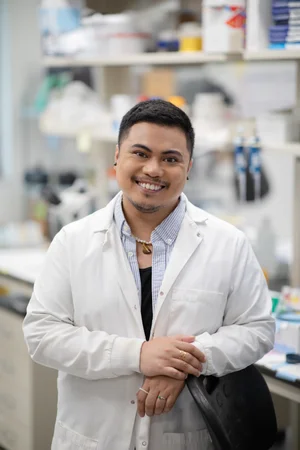
Photo of me in April 2024 about to give my first ever lecture, a guest lecture entitled "Characterization of Bioadhesive Proteins" for the graduate-level course "Biological and Bioinspired Materials" at the University of Toronto.
My story as a teacher begins with my story as a student. Growing up, I always sensed that I was “weird”, or at least that I thought and behaved in ways that may seem different or even unacceptable. I attribute a lot of my perspective on the world to the unexpected death of my older sister shortly before I started kindergarten. From the beginning of my socialization with other children my age, my life was split into two parts: the grief at home and the optimism of a learning environment at school. Scholarship was my way of understanding and fitting in the world. It was through the lens of loss and chaos that I learned to navigate and ultimately appreciate complexity and randomness. This perspective remained in me as I moved on to rigorous scientific endeavours.
I never really saw myself as particularly bright or academically inclined. In fact, I believed that I was quite the opposite. Through various sources, implicitly and explicitly, I’ve internalized the script that I am worthless and destined to fail. I gave myself the task of proving daily that I deserve to take up space. Grades and extracurricular activities were my measures of success. I learned early on that aspiring to become a doctor would please those around me. I see now that this aspiration was tied to my hope that I could bring my sister back and tied to my need to survive.
I would often binge-watch Khan Academy tutorials and Periodic Table of Videos on YouTube as a way of quenching my curiosity as well as dissociating from the chaos at home. This amount of time absorbing science knowledge proved to benefit me greatly, as I learned the basic concepts of more advanced science courses as well as different pedagogical approaches to supplement what I was exposed to at school. Ultimately, I chose to study at McMaster University in the Integrated Science program. The program allowed me to explore science at a basic level without the pressure of always applying it to medicine, though practising medicine was always a running goal for me throughout.
Undergrad was a wild time for me. I could finally explore whatever I wanted. The internal pressure and expectations I had for myself caused me an unnecessary amount of stress and feelings of failure. When I wasn’t able to find a research supervisor during summer, I felt like my career was over. I founded a club and signed up for several extracurriculars at a time because that is what I thought was required to be successful. I struggled to find soft places to land; I couldn’t bear to be alone with my thoughts and feelings. But gratefully, I found folks in various spheres who kept me afloat enough to graduate.
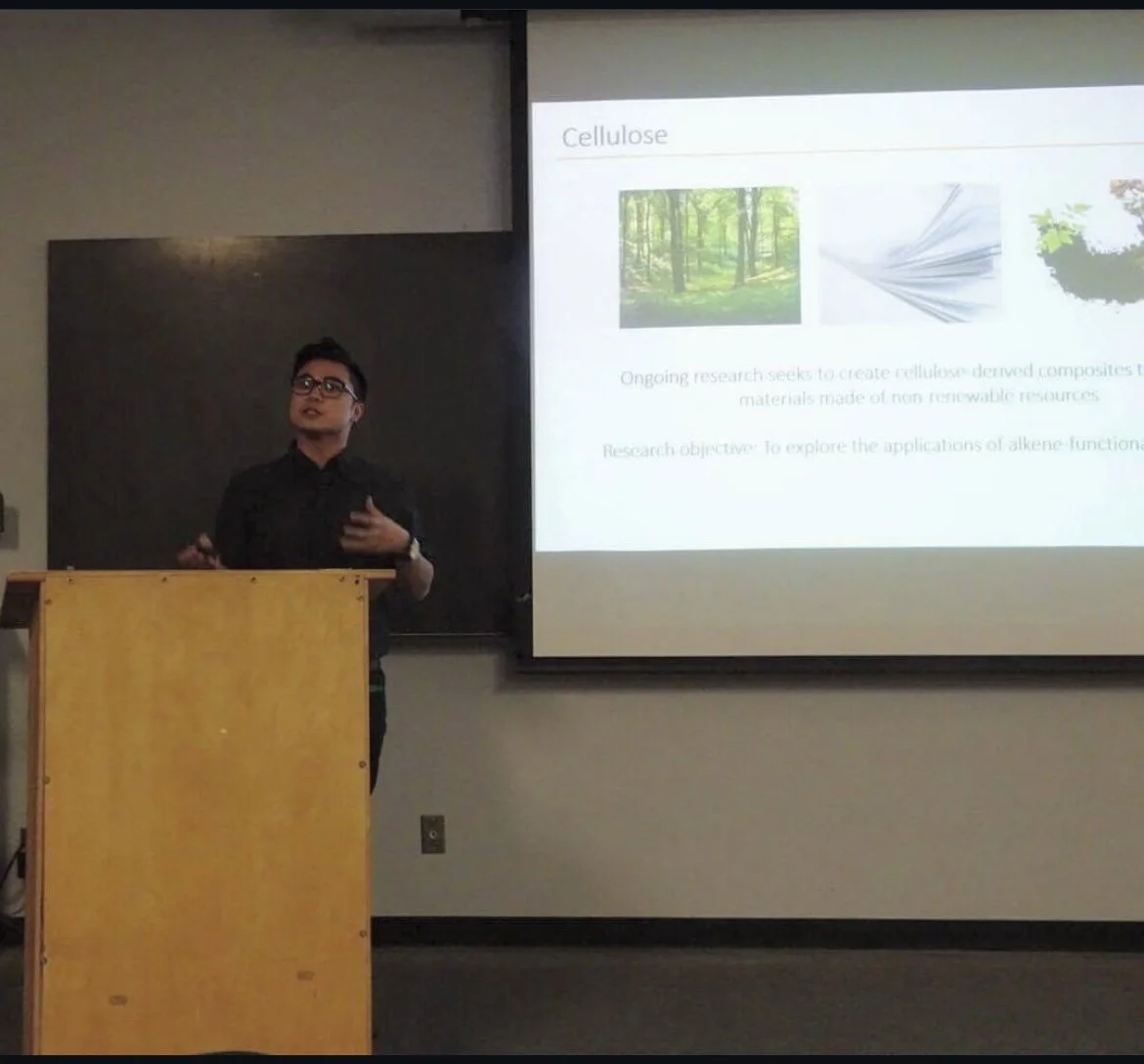
Image of me in 2017 presenting my Honours Bachelor of Science thesis on tuning the surface properties of cellulosic materials at McMaster University.
Even though I accomplished the remarkable feat of graduating from a tough program, I felt like I failed because I did not get into medical school. I was off the conveyor belt without a next step waiting for me. This particular time was pivotal in my perspective on my life and life in general. I learned that all adults were simply trying their best and that there was no single script that fits everybody. I gave myself the space to think deeply about what I wanted to do next, not necessarily what I wanted to do for the rest of my life.
I realized that I found comfort and confidence in academic science. I loved wrapping my head around complex and nuanced topics and sharing my understanding with other curious folks. And so, after a year of collecting myself (and saving some money) I applied to graduate school. I didn’t have the grades to directly be admitted to a PhD program, but my supervisor saw potential in me. He didn’t give up on me as I struggled to learn what it’s like to be stable. And boy did I struggle.
It's no surprise, however, that my success in science lately is directly proportional to the amount of healing and integration of my full self that I worked so hard to achieve. At the beginning of my PhD, I started therapy and healing from what’s known as “Complex Post-Traumatic Stress Disorder”. Years of difficult internal work, treating my mental health as a “mini-PhD in me”, I now realize that I do not need to pick and choose which parts of myself that I need to wear on any given day. I can continue to choose to bring my full authentic self wherever I go, unapologetically.
All this together, I can point to several points in my life where a seed was planted in my mind. A smile at class, an interesting question at a scientific presentation, or an adult who saw what I could offer and gave me a chance. None of these experiences defined my whole future, but all of it together defines who I am now and where I am headed.
We are all continually learning and we are all contributors to the global learning environment, whether it be learning out of curiosity or out of necessity for survival. My hope as a teacher is to help all learners see the interconnectedness of life experiences beyond their formal education.
The statements in my teaching philosophy below reflect my story and my approach to the cultivation of seeds of knowledge.
My Teaching Philosophy
-
Regardless of an individual’s educational background, their level of ability, or “level of intelligence”, a concept or skill can be learned.
-
In the mind of each learner is an intricate map or web of knowledge illuminated by their lived experiences. The connections between pieces of knowledge are either strengthened or inadvertently “misconnected” depending on how they use that knowledge and on the experiences that were built from those foundational concepts. Every resulting web of knowledge found within a student is valid and it is not up to me to construct or reconstruct it. Rather, I aim to help learner’s build and expand from their current web of knowledge. The expansion and improvement of the real/objective world (which is often the goal of education) begins with the expansion and improvement of a learner’s own inner world.
-
It is not enough to see individual components of a system. To fully understand it, the concept needs to be rooted in a network of concepts. The learner must perturb that concept from several angles to determine the boundaries of which the concept holds true. My job as a teacher is thus to support these conceptual experiments, to calibrate the learner’s assessment of the results of these perturbations, and to establish a method of knowledge exploration that can be carried over throughout their education.
-
My subject matter surrounds looking at nature to solve present-day problems. My teaching approach reflects the fact that there is an abundance of knowledge in the world, whether it is encoded in DNA or written in books. This knowledge is extant in the present-day only as a result of evolutionary processes of iteration; what works stays, and what does not work becomes extinct. Higher education is a place for an individual to determine their relationship to this knowledge and assess the accessibility of that knowledge. I aim to help students navigate their relationships with what is known and what is not yet known. The learner must practice using knowledge in different contexts, including in the context of communicating with other learners. This way, the learner can determine what knowledge is subjective and what knowledge is objective at the universal level. The intersection of subjective and objective knowledge will help the learner internalize the concept at a deeper level.
-
Once the individual establishes a connection with the subject matter, the subject matter cannot live by itself within the individual’s mind. Otherwise, it risks being forgotten, suffocated by the darkness of a clouded mind. Given that individuals have their own unique internal webs of knowledge, the communication of their understanding can help everyone strengthen their own perception of the subject. Further, the communication of knowledge builds a community founded on a common understanding of a subject. The members of this community can then propagate their knowledge as they move forward in their own educational trajectories. As such, the seeds of knowledge continue to grow and evolve exponentially.
-
A system that evolves iteratively, as is the case in the process of learning, benefits from diversity. In the context of my PhD research, zebra mussels and quagga mussels are largely regarded as a nuisance and invasive species. Indeed, the interactions of an introduced entity with original populations and the rate of introduction contribute to both the detriment and the often-overlooked benefit of various parts of a system. It is important to recognize both aspects of an entity in that space, to see the full picture, including overlapping identities and lived experiences. In doing so, the learning environment, or any system for that matter, is ultimately enriched and strengthened.
-
As an educator, it is not enough to simply present knowledge; anybody can read a textbook. It is important to communicate the implicit impact of the subject matter on myself and my work. This is reflected in my non-verbal communication of the enthusiasm and passion for the subject. It is also reflected in the way I communicate my opinion of knowledge. I do not expect learners to mimic my perspective, but rather I aim to model an authentic relationship of a person and a subject. Having witnessed a genuine connection with the subject matter, the learner may be implored to develop their own connection with it as well.
These statements of my teaching philosophy reflect my dedication to the cultivation of genuine knowledge building. The current landscape of knowledge may change drastically in a decade or century, as it has changed decades and centuries ago. The process of learning that knowledge endures. My work as an educator is to help individuals navigate the boundaries of knowledge confidently. There is no objective metric to assess this aim, but with my teaching philosophy, I will continue to gather fulfilling experiences of knowledge exploration.